
FAQs
Information Sessions and Survey
What are these information sessions about?
Southern Downs Regional Council is holding information sessions to gather your views on Council’s priorities over the next five years and to explain how ratepayers’ money will be invested across the region. These sessions are your chance to learn more, ask questions and share your thoughts on Council’s draft 2026-2031 Corporate Plan and draft 2026-2027 Budget and Capital Program.
What is the community survey about?
The survey, available online and in hard copy, will ask questions about your views on the draft Corporate Plan and Budget.
What will I learn at the information sessions?
The information sessions will provide information about Council’s priorities and plans over the next five years as part of the Corporate Plan, as well as an overall snapshot of where your rates are invested across services and infrastructure. We’ll break things down so it’s easy to understand, and Councillors and Council staff will be available to answer any questions you may have
Do I need to attend more than one information session?
No, all sessions will cover the same key information, so you only need to attend one. Just pick the time and location that suits you best. You’re welcome to come to more than one if you’d like, but it’s not necessary.
Who should attend?
Everyone is welcome and encouraged to attend — ratepayers, residents, business owners, and more - anyone interested in how Council is working to build a stronger region. If you live here, work here, or visit here, this information is for you.
What if I can’t attend an info session?
No worries, you can still learn about the Corporate Plan and Budget online. Head to haveyoursay.sdrc.qld.gov.au/corporateplanandbudget to share your thoughts or access more information. You can also learn more by contacting Council on 1300 697 372 or via email to budget@sdrc.qld.gov.au.
How will my feedback be used?
Your feedback will help Council understand what matters most to the community and help shape the final Corporate Plan. Insights will also help guide Council’s future decisions and priorities throughout the region
2026-2031 Corporate Plan information
- How Council allocates resources and sets budgets.
- The services, programs and infrastructure Council delivers.
- How Council measures progress and reports back to the community.
- Maintain before expand
- Reliable before additional
- Affordable before aspirational
- Regional before individual.
What is a Corporate Plan?
A Corporate Plan is a five-year roadmap outlining Council’s key priorities, goals and strategic direction, which is used to guide Council’s future investment and planning decisions.
It provides the framework for:
The current 2021–2026 Corporate Plan is built around the four key themes of People, Places, Prosperity and Performance.
The new 2026–2031 Plan will continue this vision, informed by community input on emerging issues such as liveability, economic development, housing, environment, infrastructure and community wellbeing.
Council is proposing a change in the draft Corporate Plan, with changes to the themes as follows:
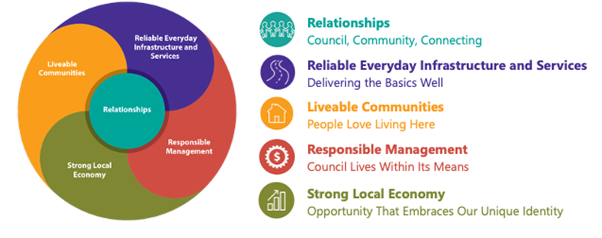
Moving forward, these themes will be known as ‘commitments’, to show the importance of delivering to our community.
Why are we writing a new Corporate Plan?
In accordance with the Local Government Act 2009, councils are required to update their Corporate Plan every five years to ensure it remains responsive to changing community needs, economic conditions and regional opportunities.
What is included in the Corporate Plan?
It provides a clear and consistent basis for decision-making, helping both our teams and the community understand how and why decisions are made. The Draft Corporate Plan sets the goals Council will work towards over the next five years. These goals include:
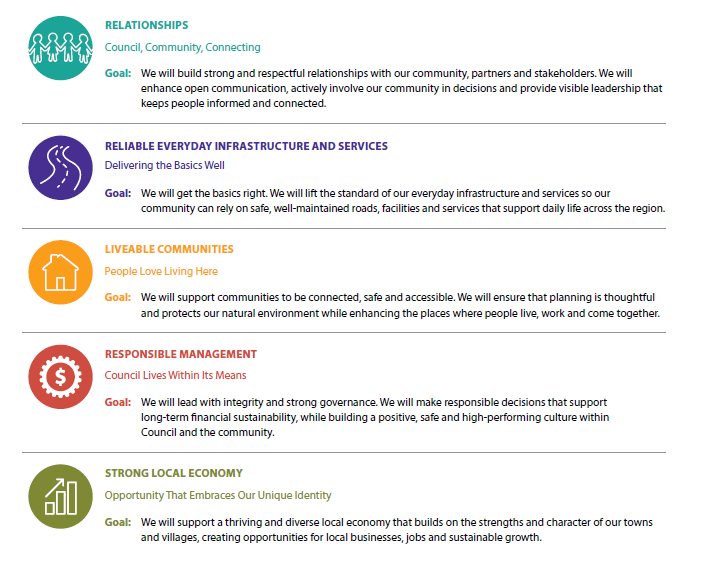
For more details, see our summary fact sheet or read the Draft 2026-2031 Corporate Plan.
What do the Corporate Plan’s future planning and investment principles mean?
Council has identified four planning and investment principles to guide how Council makes financial decisions moving forward. These are:
These principles will create a consistent and practical framework for setting priorities, supporting long-term sustainability and fair outcomes across the Southern Downs. The 2026-2027 Budget describes how Council will spend its budget in the first year of the 5-year Corporate Plan.
How has Council included community feedback in the plan?
To ensure the plan reflects the views and experiences of residents across the region, Council carried out an extensive community engagement program in late 2025 and early 2026, generating more than 1,800 responses.
This feedback has helped Council understand what matters most to you when it comes to the future of our region - from liveability and housing to local industry, environment and community wellbeing.
See the results of the 2026-2031 Corporate Plan Community Survey on Council’s website and read our summary of the Draft 2026-2031 Corporate Plan and 2026-2027 Budget & Operation Plan see how community insights have been reflected in the plan.
Budget Information
- Essential - must-do, legally required
- Core - basic services
- Community - things that help people connect
- Corporate - internal support services
- Discretionary - extras we fund when possible.
- Primary Production – 5.3%
- Non-Residential – 5.6%
- A large portion goes to roads maintenance and construction
- Some supports community services like parks, libraries, and events
- A portion covers internal operations and regulatory responsibilities.
- $860,000 – renewal of water mains in Warwick, Allora, Pratten, Leyburn, Stanthorpe, Dalveen, Killarney and Wallangarra
- $150,000 – upgrade water treatment process in Stanthorpe
- $300,000 – renewal of aging recycled water mains
- $540,000 – upgrade UV treatment system in Dalveen and Pratten
- $1.5M – upgrade of water and sewerage equipment in Warwick, including treatment plant filters and trade waste upgrade.
What does rate payer money fund?
Rates help to pay for the roads we drive on, our beautiful parks, and the community services and facilities we love. They also pay to maintain and upgrade existing facilities to ensure they are fit-for-purpose.
Council provides a wide range of services and infrastructure, from roads, waste collection, and water services, to libraries, parks, pools, animal management, economic development, and community programs. Some costs are visible, like new footpaths and park upgrades. Others, like maintaining critical infrastructure, planning, and service administration and advocacy, are less obvious but just as important.
Utility services like water, sewerage and waste management are paid for by those that use the facilities or have access to the facilities, while generally provided services like roads and parks that are available to all are paid through the general rate.
How is the budget decided?
Each year, Council prepares a budget that balances community needs, infrastructure priorities, and available funding. It’s shaped by strategic planning, service reviews, and legislation— all with consideration to rising costs and available revenue.
Council staff use important planning documents to help shape the budget. These include things like the corporate plan (our big-picture goals), the operational plan (what we’re doing this year), and the asset management plans (how we look after things like roads, parks and buildings).
Council also uses community feedback from engagement on previous budgets to identify community investment priorities and what is most important to residents.
To plan how much money we’ll need – and where it’s going to come from – Council considers a variety of factors, like how much services cost, the level of service we want to provide, any risks or legal requirements, interest rates, what grant funding is available and the overall state of the economy.
Before we think about raising rates or fees, we always check if we can cover costs with grants, contributions, or through other means.
Budget planning usually kicks off between January and March. During this time, managers and coordinators work on their area’s budget, and the Finance team brings everything together. This draft budget then goes to Council’s leadership team, Councillors and the Mayor for briefing and feedback. This process can take up to 4 months as changes are incorporated. Once all feedback has been considered and the draft budget has been fully compiled, it is sent to the Council Chambers one final time for voting and adoption, and at this meeting Council can implement their final amendments.
mendments.
How does Council prioritise what to fund?
Council works hard to make sure funding goes where it’s needed most. We look at factors like safety, risk, the laws we must follow, long-term planning, and how much benefit a project brings to the community.
Essential services – like roads, water, waste, and safety – always come first. After that, we focus on projects that help our community grow, improve liveability, and support the local economy.
We also rank projects based on how much money is available. This helps us choose what can be done in the coming year.
When it comes to day-to-day services, we group things into five types:
We aim to strike a balance between service levels, cost, and risk to get the best results for the community with the money we have.
Are rates changing?
To cover Council’s rising costs and ensure that we deliver the basics well, Council is proposing a budget with an overall median rate increase of [5.3]%. For your principal place of residence the median increase is [3.5]%, equating to an increase of between $1 and $4.80 per week. Capping will still apply to those properties that had a category change in the 2024-2025 full rates review.
Council is proposing median increases to the Primary Production and Non-Residential general rate categories, of:
Council is also planning to introduce a new rating category for properties that are not a person’s principal place of residence. The new rates category will apply to holiday homes, rental properties and other situations where the property owner does not reside at the property.
Rates on these properties will cost an additional $5.90 – $9.50 a week. Businesses with a residence currently categorised as commercial will not be impacted by this new rating category.
Why do rates go up each year?
Like you, Council is facing higher costs due to sharply rising costs of fuel, goods, services and construction. Things such as fuel, materials, labour, insurances, and leasing are all expenses that increase over time and need to be accounted for in the budget.
While the cost of products for residents in the Southern Downs is reflected by the Consumer Price Index (CPI), a separate higher pricing mechanism applies to local governments. The Local Government Cost Index (LGI) is determined by the price of products for Council, which is typically 1-2% higher than the CPI.
Council works hard to keep rate increases modest while continuing to invest in vital infrastructure and services.
How are my rates split up?
Your general rates go toward a mix of essential services. For example:
We aim to keep the balance fair and focused on long-term value for residents.
Utility charges are used only for those specific services – being water, sewerage and waste management – and are only applied to those properties that have or can access the service. So if your property cannot access a water main or receive a bin collection, you won’t be levied one of those charges.
Council also collects the Emergency Management Levy on behalf of the Queensland government, which is based on property type, risk level and land use classification, and appears on your rates notice twice per year. These fees are collected by Council and forwarded to the state government to support emergency management services.
Why can’t Council just ‘cut admin costs’ and spend more on roads or events?
Behind every service is a team of people, systems, and compliance costs that make it possible. Reducing “admin” sounds simple, but most back-end costs support frontline services. We continually review operations to find savings and improve efficiency, but it’s not always possible to shift large amounts without impacting service delivery.
What does Council not pay for?
Council doesn’t fund things like schools, hospitals, police, national parks or main roads as these are State or Federal Government responsibilities. We focus on local infrastructure and services that support the liveability and functionality of our region.
Why is so much being spent on water facilities?
Council is investing around $11.5 million upgrading and renewing water and sewerage upgrades this financial year. This includes:
Like all infrastructure, these assets age over time and require upgrades and maintenance to remain operational and safe for community use. Council is also seeking more than $51 million in State grants to jointly fund water infrastructure, over three years.
Why is so much being spent on existing facilities?
Council operates more than $1 billion dollars’ worth of assets, including roads, water pipelines and waste facilities, which need to be maintained on an ongoing basis and enhanced to meet growing needs. Each year, a portion of the annual budget is allocated to keeping key assets in good working order, for the benefit of the entire community.
Why does Council have a financial reserve?
Natural disasters can cause significant damage to our region and Council assets, costing additional money to repair. For this reason, Council cannot spend every dollar that is available right now. Having a ‘financial reserve’ in the budget is critical to ensure that Council is equipped to fund ongoing disaster recovery in the future.